5 hours, 10 hours. There are people who upload videos of themselves silently studying with their cameras on. It is called 'Study With Me'. They study alone, but they have created a sense of being 'alone together' by sharing time with someone on the screen. If mukbang and 'Get Ready With Me' shared meal times and preparation times for going out, we are now in an era of sharing even study time with others' screens.
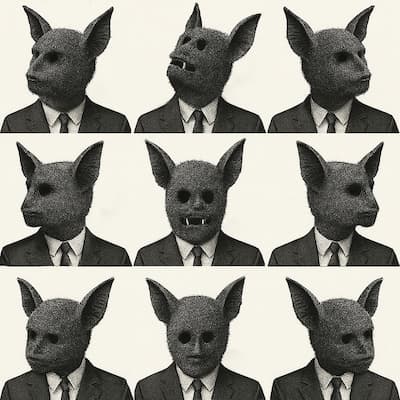
This trend is not unfamiliar in the vampire world either. Once the sun completely sets, 'blackout study' livestreams turn on one by one. With lighting minimized, they open ancient books or organize the latest papers from human society in a room with black curtains drawn. Some play very low-frequency sounds in the background, while others leave only the sound of a pen in complete silence. Some follow a routine of 25 minutes of focus and 5 minutes of rest, while others study by dividing their time into '1st period' and '2nd period'. However, if there is one commonality, it is that they show themselves studying in real-time with minimal editing. This is because sharing the flowing time itself is the core.
Why bother studying with the screen turned on? Just as marathon runners pace their speed by running with pacemakers, Study With Me becomes the pacemaker of the night. To beings living eternal lives, time seems to remain endlessly, but paradoxically, focus is more difficult. This is because the sense that "I can do it anytime" easily turns into the temptation that "I can put it off for now." Seeing others maintaining perfect concentration across the screen inexplicably provokes a competitive spirit. The feeling that someone is watching reduces distractions and makes one control oneself. It is as if the competitive psychology of the next seat in a reading room has moved online.
Recently, learning methods are also rapidly changing, centered around the 'Young Vampire' generation. If past generations relied on parchment and transcription, tablets and e-ink readers are now standard equipment. P (345 years old), who is preparing for a civil service exam, turns on a study livestream app every day during his pure study time. He studies while keeping the screens of participants preparing for medical or law exams turned on. He says, "Seeing others carving out their time maintains a sense of tension." Although they are a species with long lifespans, their exam schedules follow the speed of human society.
The 'proof of study' culture is also still valid. The 'Night Log', which records and shares the amount of study over a certain period on social media, and the 'hyper-immersion study method', which involves learning by immersing oneself in a specific worldview, are devices to reduce boredom. For example, playing the ambient sounds of a medieval library, or setting oneself as a librarian in a royal archive and deciphering ancient documents. It is an attitude of "If it's studying I have to do anyway, I will add interest to it."
Learning tools are also evolving. 'Index notes' that organize concepts in the form of small cards are drawing attention again, and flashcard apps that expand this digitally are gaining popularity. From algorithm-based review systems that aid repetitive learning, to timer apps that measure pure study time to induce competition, to study routine management apps that provide rewards when goals are achieved. Studying no longer remains a solo act. It has become a networked activity combining data, algorithms, and the gaze of others.
Someone turns on the screen for an exam, someone for adapting to human society, and another to endure tedious time. Silently keeping their study spots while stimulating and supporting each other, this is how we study together today. Let's study together, Let's Study Before Sunrise.
Alone Together. Let's Study Before Sunrise

Related news

lifestyle
Curious About Today's Omen? Fortune App 〈Night Omen〉
Around sunset, the phone screen briefly lights up. "Today's omen has arrived."
May 29, 2026 •
3 min read

lifestyle
Report Vampire Lifestyle Trends!
Vampire Now is looking for submissions on lifestyle trends that are actively embraced across vampire society.
May 15, 2026 •
1 min read

lifestyle
I'm Not Buying It This Century. The 100-Year No Buy Rule
"Last chance," "Today only special," "Sold out if not now." These phrases that work in human society are not very threatening to vampire citizens.
May 15, 2026 •
3 min read
Report a sighting